
There is a lot of information about what happens to your body in midlife.
Hormones change. Sleep can become more difficult. Your mood and cognition can shift. Sexual desire and function can change. Your periods may become unpredictable. Your body can start responding differently to things that never seemed to bother you before.¹
But there is something we don’t talk about enough: midlife doesn’t happen the same way for everyone.
One person might move through her 40s and 50s with relatively few changes. Another might suddenly find herself exhausted, unable to sleep, gaining weight, struggling to concentrate and wondering where her libido went. Someone else might experience almost none of those things but notice that sex has become uncomfortable. Another person might feel physically fine but find that her mood has changed dramatically.
And some people experience several of these things at once.
Longitudinal studies following women through the menopause transition have found distinct symptom patterns and trajectories rather than one universal midlife experience.² ³
That makes midlife particularly difficult to navigate.
We often talk about “midlife” as though it were one predictable biological event, but there is no single midlife experience. There are, however, a few things about that transition that your regular healthcare appointments may not make obvious.
1. Midlife isn’t a checklist
Healthcare is necessarily structured around questions that can be answered efficiently. Is your sleep affected? Are you having hot flashes? Has your weight changed? Are you experiencing low libido or brain fog?
Those questions are useful, but they don’t always capture what is actually happening.
Symptoms can overlap, influence one another and change over time. Research has found relationships between symptoms such as vasomotor symptoms, sleep disturbance and mood changes across the menopause transition.⁴ Other longitudinal research has identified clusters of physical, psychological, vasomotor and sexual symptoms that can follow different trajectories through midlife.² ³
The combination can also be completely different from one person to another.
This is one reason comparing yourself to friends, partners or people online can be so unhelpful. Your experience doesn’t have to look like someone else’s to be real, and there isn’t a single checklist that tells you whether you’re having a “normal” midlife transition.
2. “Normal” doesn’t always mean “nothing is happening”
This may be one of the most frustrating experiences in healthcare.
You don’t feel like yourself. You finally make an appointment. You get tested. And you’re told everything looks normal.
That can be reassuring. Sometimes it is exactly what you need to hear.
But a normal result doesn’t necessarily explain every symptom you’re experiencing.
A blood test is a measurement of your biology at a particular point in time. It can be extremely useful for identifying or ruling out certain conditions, but it isn’t a complete record of how you’ve been functioning for the last six months.
Your clinician may see your lab results, but they may not know that your energy has been gradually declining since January. They may not know that your brain fog happens four days a week but disappears on weekends. They may not know that your sleep deteriorated shortly after a medication change. They may not know that your libido has changed slowly enough that you only noticed it when you realized you hadn’t wanted sex in months.
Unless you tell them.
And even when you want to tell them, reconstructing months of health history from memory is surprisingly difficult.
3. Your clinician sees a snapshot. You live the movie.
This may be one of the biggest disconnects in healthcare.
Your appointment lasts minutes. Your symptoms happen over weeks and months.
A clinician might ask how your sleep has been, and you might say, “Not great.” But “not great” could mean very different things. Maybe you slept badly twice last week. Maybe you’ve been waking at 3 a.m. almost every night for six months. Maybe your sleep is fine except for the week before your period. Maybe you’re sleeping eight hours but waking exhausted.
Those are very different stories.
The same is true for almost every symptom. How often does it happen? When did it start? Is it getting better or worse? What happens before it? What happens alongside it? Did anything change when you started a medication? Did one symptom improve while another became worse?
Those details can matter.
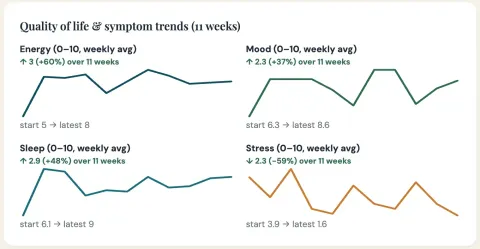
Longitudinal menopause research has demonstrated the value of repeatedly measuring symptoms over time rather than relying on a single assessment.² ⁵ But those details are difficult to capture in a short clinical conversation, particularly when the patient is expected to remember what happened weeks or months earlier.
The issue isn’t that clinicians don’t care about the bigger picture. It’s that the healthcare system is largely designed around individual encounters, while health itself unfolds continuously.
4. The question you really want answered is often “why?”
Most healthcare interventions are designed around a more immediate question: What do we do about this?
And sometimes that’s exactly the right question.
But when you’re going through a complicated transition, you often want to understand something else first: why is this happening to me?
Why now? Why has my sleep suddenly become terrible? Why am I gaining weight when my routine hasn’t changed? Why am I exhausted when my tests are normal? Why has my libido changed? Why did this medication help one symptom but seem to make another worse? Why do I feel so different when nothing seems dramatically wrong on paper?
These aren’t always questions medicine can answer immediately.
The menopause transition involves changing hormones alongside aging, health conditions, medications and psychosocial factors. Symptoms can therefore have multiple contributors, and attributing everything to a single cause isn’t always possible.¹ ⁶
But sometimes the answer becomes easier to investigate when you have a better picture of what has been happening over time.
5. The “why” often lives in the pattern
Imagine being able to look back and see that your brain fog was being reported on 61% of your days three months ago and is now occurring on 8%.
Or that a symptom you thought was happening “all the time” actually appears primarily after several nights of poor sleep.
Or that something changed consistently after starting a medication.
Or that a particular symptom tends to appear alongside several other changes rather than in isolation.
None of those patterns automatically gives you a diagnosis. But they can give you something valuable: a better question to take to your clinician.
And sometimes that is the missing piece.
Not necessarily more information, but better-organized information.
6. This is where longitudinal health data gets interesting
We recently spoke with the team at Allvi, a health platform built around capturing what happens between healthcare visits.
Instead of relying entirely on someone to remember what happened over the previous few months, Allvi collects regular information about symptoms and wellbeing and organizes it into a longitudinal picture.
The early cases the team shared with us are interesting because they demonstrate what can become visible when you stop looking at health as a series of isolated appointments.
In one case, a member had been experiencing hair loss almost every day. By day 56, it was being reported on just 17% of tracked days. Her brain fog had been present on 61% of days at the beginning and was down to 8%.
That’s not a lab result. It’s a record of someone’s lived experience changing over time.
In another case, 54 days of continuous data helped surface nine biomarkers that hadn’t previously been tested and identified a potential medication-absorption concern.
The data didn’t diagnose the issue. The doctor reviewed the information and made the clinical decisions.
In a third case, daily tracking surfaced a pattern of nocturnal hypoglycaemia that had not previously been diagnosed. A medication was identified as a likely contributor, and after the clinician made a change, the pattern resolved.
These are examples shared with us by the Allvi team; they aren’t independent clinical-trial findings.
And that’s an important distinction.
The point isn’t that technology somehow “solved” these people’s health problems. The clinician still made the medical decisions. What changed was the amount of context available to them.
7. Maybe we don’t need more health information. Maybe we need better health history.
We often talk about the future of healthcare as if it will be defined by increasingly sophisticated tests, devices and AI.
Those things will undoubtedly matter.
But there is another, much simpler problem to solve: how do we make better use of what is already happening to people between appointments?
A doctor may have fifteen minutes with you. Your body has had three months.
There is an enormous amount of information in that difference. The question is how much of it makes its way back into the clinical conversation.
This is particularly relevant in midlife because there is so much individual variation. Your sleep, energy, mood, metabolism, hormones, medications, activity and sexual wellbeing can all change at different rates and interact in ways that aren’t obvious from a single appointment.¹ ² ⁴
And not every connection will be medically meaningful.
Sometimes you’re stressed. Sometimes you’re sleeping badly. Sometimes your body is going through a normal transition. Sometimes there is something worth investigating. Sometimes a symptom has several contributing factors.
The point isn’t to turn every fluctuation into a diagnosis.
The point is to have enough information to ask better questions.
So, what should you actually do with this?
Not every symptom needs to be tracked. Not every fluctuation needs an explanation. And definitely not every change in midlife means something is medically wrong.
But if something has changed and stayed changed, it can be useful to start paying attention to it more systematically.
When did it start? How often does it happen? Is it getting better or worse? What else is happening around the same time? Did anything change before it started? What happens when you change something?
And perhaps most importantly: what would your clinician need to know to understand the last three months of your health, rather than just the fifteen minutes in front of them?
That is a very different way of approaching midlife.
Instead of waiting until a symptom becomes unbearable and then trying to reconstruct what happened, you start building a picture while you’re living through it.
You aren’t trying to diagnose yourself. You’re trying to understand yourself well enough to have a better clinical conversation.
One company trying to close that gap
That’s the premise behind Allvi.
The platform is designed to help people capture their health experiences between appointments, identify patterns over time and create structured summaries that can be used alongside clinical care.
It isn’t a replacement for your doctor, and it doesn’t diagnose or prescribe. The idea is simpler: give your clinical team a better record of what has actually been happening between visits.
Midlife isn’t a problem to solve
Perhaps this is the bigger point.
We have become very good at treating midlife as something to manage: fix the sleep, address the weight, treat the symptom, investigate the sexual changes, run the test, try the intervention.
But midlife isn’t a single problem.
It’s a transition.
And transitions are messy.
They happen differently in different bodies. They unfold over time. Some changes are temporary. Some are worth investigating. Some are completely normal. Some have nothing to do with hormones at all.
The challenge is knowing which is which.
And for that, we may need to move beyond the idea that a person’s health can be understood from a handful of measurements taken months apart.
Your clinician has expertise. Your tests have information. But you have the longitudinal experience of living in your body every day.
The opportunity is to bring those three things together.
Because perhaps the most useful question in midlife isn’t simply, “What’s wrong?”
It’s: “What has been changing, and what might explain the pattern?”
That is a much harder question.
But it may also be a much more useful one.
Sources
¹ The North American Menopause Society. The 2022 hormone therapy position statement of The North American Menopause Society. Menopause. 2022.
² Mishra GD, et al. Health symptoms during midlife in relation to menopausal transition: British prospective cohort study. BMJ. 2012.
³ Woods NF, et al. The Seattle Midlife Women’s Health Study: a longitudinal prospective study of women during the menopausal transition and early postmenopause. Menopause.
⁴ Maki PM, et al. Associations between vasomotor symptoms, sleep disturbances, and frequent mood changes individually and within symptom groups across the menopausal transition and early postmenopause. Menopause. 2026.
⁵ Dennerstein L, et al. Longitudinal research on symptom and hormonal changes across the menopausal transition. Human Reproduction Update.
⁶ Santoro N, Epperson CN, Mathews SB. Menopausal Symptoms and Their Management. Endocrinology and Metabolism Clinics of North America.